

Guide
What is a Mutual Fund?
A mutual fund is a financial vehicle that pools money from multiple investors to purchase a diversified portfolio of stocks, bonds, or other securities. Managed…
Plan your financial future with our SIP, EMI, FD, CAGR calculators and master investing through bite-sized lessons — all free, no signup needed.
Plan smarter with accurate, instant calculations. No account needed.
Estimate returns on your monthly Systematic Investment Plan.
Calculate now →Calculate equated monthly instalments for home, car or personal loans.
Calculate now →Find out maturity value of your Fixed Deposit at interest rate.
Calculate now →Plan your Recurring Deposit and forecast maturity amount.
Calculate now →Estimate returns on a one-time lumpsum mutual fund investment.
Calculate now →Calculate Systematic Withdrawal Plan payouts from your corpus.
Calculate now →Curated guide collections to help you master investing topics step by step.
2 Guides
Comprehensive articles written for Indian investors.
A mutual fund is a financial vehicle that pools money from multiple investors to purchase a diversified portfolio of stocks, bonds, or other securities. Managed…
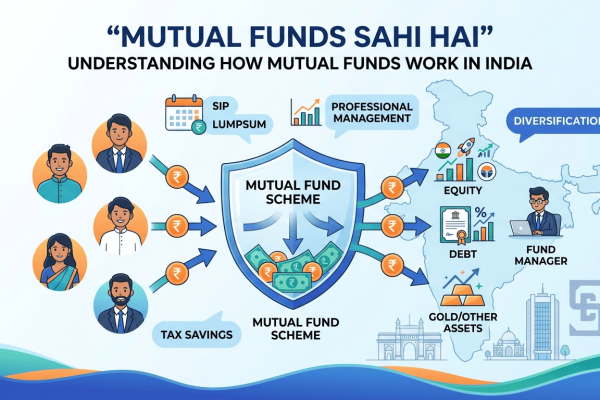
In India, mutual funds operate within a highly secure, three-tier framework regulated strictly by the Securities and Exchange Board of India (SEBI). Managed by professional…
Stay up to date with investing insights and market education.
Welcome to WordPress. This is your first post. Edit or delete it, then start writing!
A SIP (Systematic Investment Plan) calculator helps you estimate the future value of your monthly SIP investments using the compound interest formula. Enter your monthly amount, expected return rate, and investment duration to see projected returns.
EMI (Equated Monthly Installment) is calculated using the formula: EMI = P × r × (1+r)^n / ((1+r)^n - 1), where P is the principal loan amount, r is the monthly interest rate, and n is the number of monthly installments.
In SIP, you invest a fixed amount every month, which averages out market volatility (called rupee cost averaging). In lump sum, you invest the entire amount at once, which can be riskier but may generate higher returns if timed correctly.
CAGR (Compound Annual Growth Rate) measures the annual growth rate of an investment over a specified time period, assuming profits were reinvested. It helps compare the performance of different investments on an equal footing.
The expense ratio is the annual fee that all funds or ETFs charge their shareholders. It covers management fees, administrative fees, and other operational costs. A lower expense ratio means more of your returns stay in your pocket.
AI Stock Lens is a financial education platform providing informational content only. We are not SEBI registered investment advisors. Content on this site is for educational purposes and should not be construed as investment advice. Please consult a SEBI-registered advisor before making investment decisions.