
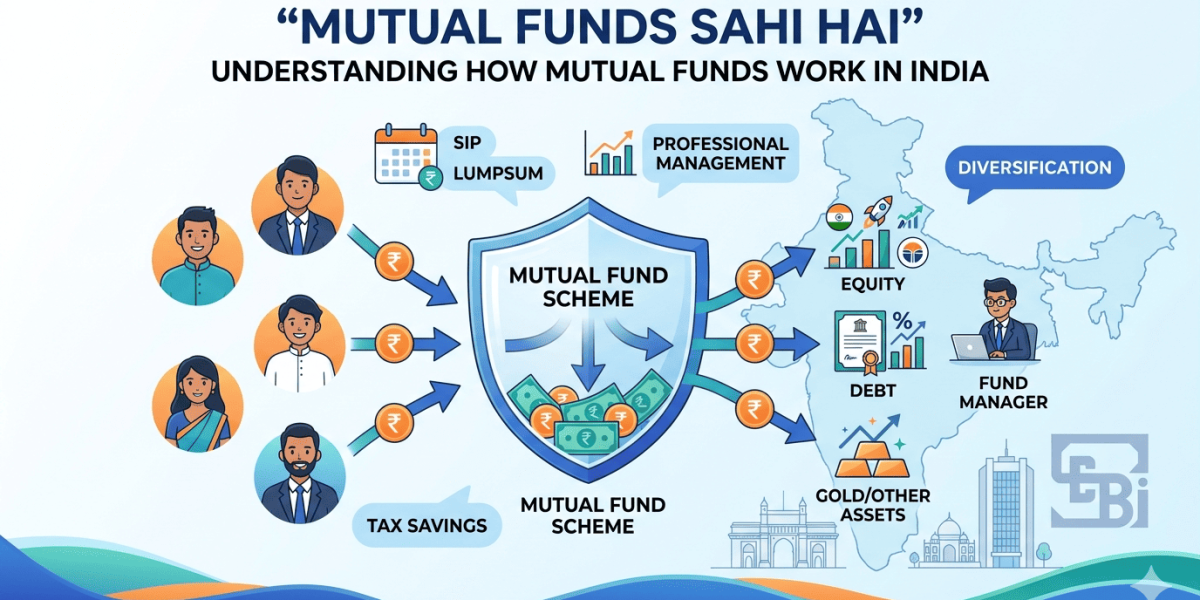
In India, mutual funds operate within a highly secure, three-tier framework regulated strictly by the Securities and Exchange Board of India (SEBI). Managed by professional Asset Management Companies (AMCs), they allow everyday retail investors to access India’s rapid economic growth through equities, corporate debt, and government bonds.
India’s Mutual Fund Revolution: How the System Works
The Indian mutual fund market has witnessed an unprecedented boom, shifting from traditional savings like fixed deposits to market-linked investments. Programs like “Mutual Funds Sahi Hai” by the Association of Mutual Funds in India (AMFI) have simplified the ecosystem for millions.
Here is exactly how the entire machine runs under the hood in India.
1. The Secure Three-Tier Structure
To protect investor capital, SEBI enforces a mandatory structural division:
[ Sponsor ]  --> Creates the Trust
     |
[  Trustee  ] --> Protects Investor Interests & Monitors compliance
     |
[   AMC     ] --> (Asset Management Company) Fund Managers deploy the cash
- The Sponsor: The promoter company (like a bank or corporate house) that sets up the fund.
- The Trustees: The ultimate guardians. They ensure the AMC manages the fund according to the promised objective.
- The AMC: The actual money managers (e.g., SBI Mutual Fund, HDFC Mutual Fund) who hire professional fund managers to make market bets.
2. Net Asset Value (NAV) and Unit Allocation
When you invest money, you receive fractional parts of the fund called units.
- The cost of one unit is the Net Asset Value (NAV).
- Unlike stock prices that twitch every second, India’s AMCs calculate and publish the final NAV of a fund once a day after the market closes at 3:30 PM.
- Example: If you invest ₹10,000 in a fund with an NAV of ₹100, you are credited exactly 100 units.
3. Systematic Investment Plan (SIP) vs. Lumpsum
The massive growth in Indian retail investing is fueled by the flexibility of how you can pay:
- SIP (Systematic Investment Plan): Automatically deducts a fixed amount (as low as ₹100 to ₹500) from your Indian bank account monthly. This leverages Rupee Cost Averaging—buying more units when the market falls and fewer when it rises.
- Lumpsum: A one-time bulk investment when you have a surplus of cash.
4. The Critical Choice: Direct Plan vs. Regular Plan
Every mutual fund scheme in India is mandated by SEBI to offer two parallel versions:
| Feature | Direct Plan | Regular Plan |
|---|---|---|
| Intermediary | None (Buy directly from the AMC or direct apps) | Agents, Brokers, Distributors, or Banks |
| Commissions | Zero distribution fee | Includes ongoing commissions paid to agents |
| Expense Ratio | Lower (Keeps more profit in your pocket) | Higher (Deducted from your fund value) |
| Long-Term Return | Higher compound returns over time | Slightly lower returns due to recurring fees |
5. Tax Rules on Indian Mutual Funds
Profits earned from your mutual funds are subject to capital gains taxes based on asset type and holding periods.
- Equity Funds: If you sell within 1 year, you pay Short-Term Capital Gains (STCG) tax. If you sell after 1 year, you pay Long-Term Capital Gains (LTCG) tax, with an annual exemption limit on a portion of the gains.
- ELSS (Equity Linked Savings Scheme): A special category of equity funds that offers tax deductions up to ₹1.5 Lakhs per year under Section 80C of the Income Tax Act, carrying a mandatory 3-year lock-in.
6. Your Action Plan to Invest in India
Getting started in India is completely paperless and takes under ten minutes:
- Complete your PAN & e-KYC: Authenticate your identity online using your PAN card and Aadhaar-linked phone number.
- Choose a Platform: Pick an online platform (like Groww, Zerodha Coin, or the official AMC websites).
- Pick your Category: Align your horizon. Choose Large-cap equity for stability, Mid/Small-cap for high growth, or Debt funds for short term safety.
- Set Up an Auto-Pay Mandate: Link your bank via UPI or Net Banking to automate your monthly SIPs.